
Is Legislation Enough to Stop Police Brutality of Black People?
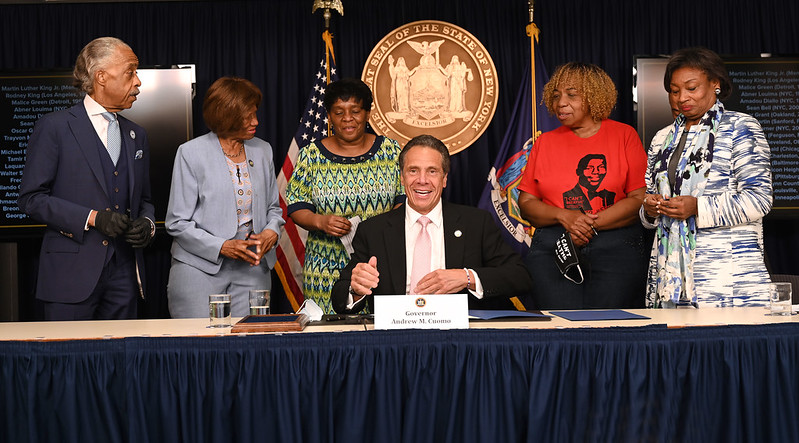
New York Governor Andrew Cuomo signs the “Say their Name” legislation.
As 2020 ends, no one will forget the high-profile police murders of countless unarmed African Americans like Breonna Taylor and George Floyd which happened earlier this year. After their deaths, massive protests took place nationwide, then new legislation was signed in multiple cities and states across the country to stop excessive force by the police.
Earlier this month, Virginia Governor Ralph Northam signed “Breonna’s Law” which bans no-knock warrants. The law is named after Taylor, an Emergency Medical Technician, who was killed in her Louisville, Kentucky home in March. Police busted into her apartment in the middle of the night looking for a suspect accused of selling drugs. Taylor was shot eight times by the police. Her boyfriend, Kenneth Walker, who was with her was also shot. Then he was arrested since he shot at the police who he believed to be intruders.
Virginia is the first state to ban no-knock warrants in response to Taylor’s death according to a statement on the Governor’s website. Virginia followed in the footsteps of the Louisville City Council who passed “Breonna’s Law," in June, which also bans no-knock warrants.
“This is one of many critical steps on police reform that we’ve taken to create a more peaceful, just, compassionate and equitable community,” said Louisville Mayor Greg Fischer on Twitter when he signed the law.
In New York, Governor Andrew M. Cuomo signed the 'Say Their Name' Reforms in June. According to the Governor’s webpage, the law mandates the following:
• Allowing for transparency of prior disciplinary records of law enforcement officers by repealing 50-a of the civil rights law.
• Banning chokeholds by law enforcement officers.
• Prohibiting false race-based 911 reports; and
• Designating the Attorney General as an independent prosecutor for matters relating to the civilian deaths.
However, is the “Say their Name” legislation and similar laws enough to prevent the mistreatment of African Americans at the hands of the police. Over the summer, community leaders in New York shared their views on the legislation.
Nana Zakia, an activist for over 20 years who founded the Women of Proverbs 8 Council, Inc, an organization that provide workshops from spiritual healing to dealing with police brutality.
“It is a very good start because we are in the 21st Century. And if you know anything, every 100 years, history can and does repeat itself. That's why the old people say there's nothing new, the more things change, the more they stay the same. … Last [century] it was just called public lynching. Ok, this is now called police brutality,” Zakia said.
“So, we’ve had this eight minutes and 46 seconds [the amount of time a white police officer held his knee on Floyd’s neck] for a very long time. But it is a very good beginning because now we get to see who all of the officers are who do have bad records, who are racist who do injustice to our people,” she continued.
On the other hand, one politician who represents East New York, a majority Black community in Brooklyn, is not satisfied.
“It was watered down, ineffective, and it’s not going to put a dent into what the police are doing to us. Banning the chokehold, making it illegal didn’t stop them from choking us, some of us to death. Background checks, 50-A. They made a big deal over that; do you care about the background check of a police officer who is choking you to death? Suppose he has a good background; we want that man in jail.
“None of this legislation ensures that they will be punished to the fullest extent of the law when they murder us, assault us, choke us, call us out of our names, brutalize us. There’s no piece of legislation that was passed that will put an end to that,” said New York State Assemblymember Charles Barron.
“The only thing that will put a dent in that is to dismantle the police force as it exists and restructure the police force so the community will have power and control over police personnel and policing policies. And in the meantime, have an independent prosecutor that will prosecute them to the fullest extent of the law. As well as an independent Civilian Complaint Review Board that will punish them for offenses against the people,” Barron continued.
One aspect of the law pertaining to police misconduct investigations raises eyebrows for Judge Yvonne Lewis, Retired, from Brooklyn.
“It makes complete sense to me that the Attorney General’s office should investigate cases of police misconduct. However, it should not just be the police there because we have seen in the past, that it does not go well for an organization to investigate their own. And even when it does manage to have some repercussions, the perception is that it [investigation] is not done effectively,” Judge Lewis said.